Ir directamente al contenido
  • Por qué deberíamos tomarnos en serio las experiencias de los demás y actuar de una manera extremadamente responsable frente a ellas.

    2 de febrero de 2024
    Sin categoría

    La forma en que la mayoría de los humanos clasifican lo que importa generalmente no sigue lo que realmente lo hace. Nuestra programación predeterminada está optimizada para rastrear cosas que nos ayudaron a reproducirnos y sobrevivir en nuestro paisaje ancestral y para «pintarlas» de manera que estas se sintieran como si estas fueran las cosas que realmente nos importasen. También tienden a sentirse como si estuviéramos en contacto directo con la cosa externa y su esencia. Todo esto en realidad no es cierto, nuestras experiencias de las cosas son en realidad representaciones internas isomórficas a lo que está fuera nuestro. Cada vez que ves algo fuera de ti, la luz que refleja llega a tu retina, lo que activa tu nervio óptico, que envía señales a tu cerebro donde se hace una representación que es lo que en realidad estás experimentando. Lo mismo ocurre con todas las demás sensaciones del «mundo exterior». Muchas personas dirían si se les pregunta, que esto es obvio, pero muchas veces no lo entienden realmente, o no llevan esta línea de razonamiento lo suficientemente lejos como para que empiece a afectar la forma en que actúan, o la siguen solo parcialmente de maneras que los llevan a concluir que nada realmente importa, actuando así también de manera irresponsable.

    Nuestro cerebro hace una representación/simulación de la realidad, eso es en lo que «vivimos»/somos, de cartoon epistemology.

    Las cosas (o mejor dicho, las experiencias) fuera del bolsillo que somos sí importan, y mucho. De la misma manera que las partículas pueden tener cargas o la materia tiene diferentes temperaturas, cada experiencia tiene una característica que hace que se sienta bien, mal o de una manera neutral, esa característica es la valencia, la valencia es lo que construye el eje placer-dolor. El hermoso olor de las fresas generalmente tiene una valencia positiva, lo mismo que la alegría, mientras que el dolor o el temor existencial generalmente tienen una valencia negativa. Aunque alguien podría decir que la experiencia de ver, por ejemplo, como sucede un evento particular es subjetiva y puede ser diferente dependiendo de a quien se le pregunte, o la experiencia de escuchar la misma canción, o ver el mismo objeto puede ser mejor o peor para diferentes personas, haciendo así que el valor sea relativo, yo argumentaría que esa conclusión es solo el resultado de intentar medir el valor de manera incorrecta. El valor en realidad reside en las experiencias, tu representación del holocausto muy probablemente tiene un tono negativo, mientras que la de alguien que lo apoyó puede tener uno positivo, pero esas opiniones no cambian las experiencias de quienes lo vivieron, su sufrimiento sigue siendo malo. También podemos notar que lo que hace que diferentes representaciones del mismo fenómeno se sientan de mejor o peor manera es la estructura de esas experiencias, y así, si una canción te pareció hermosa un día y al siguiente horrible, esto en realidad es causado por diferencias en las formas y estructuras de estas representaciones (probablemente lo que determina qué tan buenas o malas son esas estructuras son sus niveles de consonancia y disonancia). La valencia es real, las experiencias horribles son realmente, verdaderamente horribles y las hermosas son realmente hermosas. Esto se hace evidente para quien se ha roto una pierna, para quien sufre de dolor crónico, o para quien está teniendo una experiencia increíblemente intensa y llena de amor con MDMA. Otra forma en la que puedes pensar sobre esto es dándote cuenta de que tu momento de experiencia actual es «lo que es» y se siente tan bien, mal o neutral como se sienta, independiente de las opiniones que alguien más pueda tener sobre este, lo mismo aplica para todos los demás momentos de experiencia del universo.

    Creo que deberíamos actuar con extrema responsabilidad hacia esos momentos de experiencia con valencia tan intensa, el que no nos importe tiende a doler después, mucho. La mayoría de las personas reconocerán que conducir borracho es bastante tonto e irresponsable, lo mismo que enfrentarse a un ladrón con un cuchillo cuando no tienes uno, pero creo que deberíamos aplicar ese cuidado y seriedad sobria hacia muchas otras cosas, tomando también en consideración el hecho de que las peores y mejores experiencias tienen exponencialmente más valor que las cosas que usualmente experimentamos, como Andrés Gómez Emilsson escribe en Logarithmic Scales of Pleasure and Pain: Rating, Ranking, and Comparing Peak Experiences Suggest the Existence of Long Tails for Bliss and Suffering.
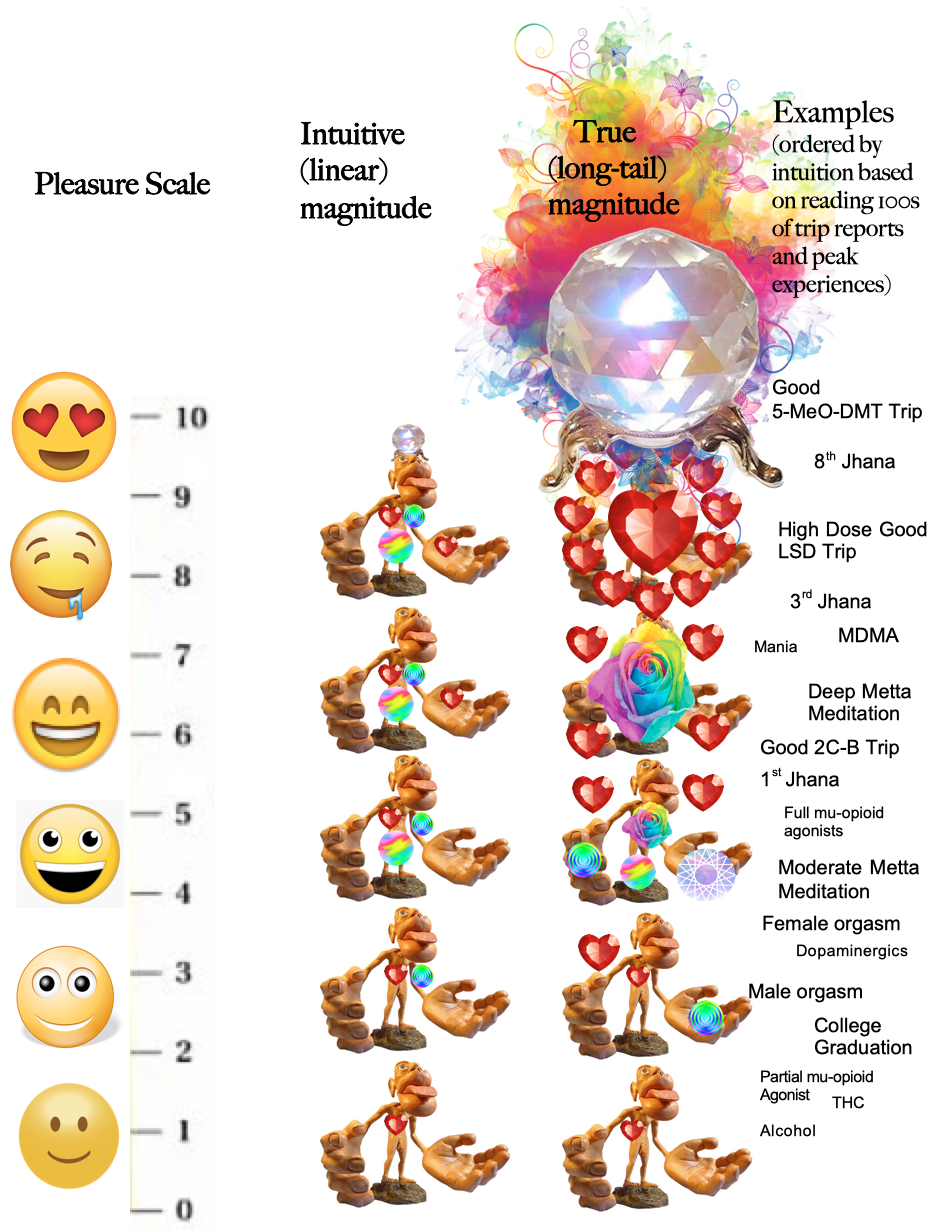
    Aunque podamos imaginar que las experiencias crecen en intensidad linealmente, hay muchas razones para creer que en realidad lo hacen exponencialmente.

    Para alguien que vivió hace 20,000 años, muchas cosas que nos importan hoy, digamos nuestras calificaciones en la escuela o las interacciones a través de las redes sociales, probablemente serían extremadamente extrañas e inesperadas. Yo diría que, después de tomar una mirada sobria y seria en la naturaleza real del valor y dejar que eso actualice honestamente las cosas que priorizamos y las formas en que actuamos, también terminamos con una forma bastante diferente de ver el mundo y sobre lo que deberíamos hacer, la cual puede ser bastante inesperada. Ahora comenzamos a pasar mucho tiempo tratando de encontrar formas de abortar cefaleas en racimos, maneras de tratar mejor el dolor crónico, o comenzamos a ver las cosas increíble y extremadamente horribles que suceden en la industria ganadera a través de una perspectiva diferente a la humana usual en el que solo parece algo lejano que está, mediante alguna lógica dudosa, justificado, incluso comenzamos a dudar de las formas en las que deberíamos actuar ante la existencia del sufrimiento de los animales salvajes, y comenzamos a preocuparnos mucho más por intentar que nuestro futuro vaya en buenas direcciones, entre muchas otras cosas.

    Imagina que hubiera alguien que tuviera un botón que activara una máquina que le cortaría el dedo 10 minutos después de presionarlo, pero tuviera un poco de diversión al presionarlo y eligiera hacerlo voluntariamente, claramente no muy inteligente, ¿quién en su sano juicio lo presionaría? Yo argumentaría, sin embargo, que esta categoría de problemas también incluye los tipos de cosas mencionadas anteriormente, la gente toma decisiones basadas en sus deseos inmediatos y no considera el efecto que eso puede tener en otros lugares/momentos.

    Una perspectiva importante para agregar a esto es de la identidad personal. ¿Cómo podemos estar tan seguros de que somos un ser separado e independiente que sobrevive a través del tiempo? ¿qué es lo que cargaría nuestra identidad a través del tiempo? ¿nuestros recuerdos? no son agujeros de gusano hacia el pasado, solo son formas que toma nuestro cerebro que hacen que representaciones de cosas que nos han sucedido reaparezcan en nuestra experiencia, además, si alguien tuviera los mismos recuerdos, ¿serían automáticamente la misma entidad que tú en otro lugar? ¿por qué? si perdieras tus recuerdos, ¿de repente te convertirías en una entidad diferente?, los recuerdos no son entidades fundamentales, solo son estructuras particulares que toma nuestro cerebro, nuestros átomos también están cambiando todo el tiempo, lo mismo ocurre con la forma de nuestro cuerpo (que como decía, no es fundamental, dos cuadrados con el mismo ancho y longitud no son el mismo cuadrado solo porque su forma sea compartida), yo argumentaría que no es posible encontrar tal portador constante «solo tuyo» de identidad, y que si estamos dispuestos a aceptar que lo que somos sobrevive con el tiempo, tendríamos que también aceptar que ese portador de identidad es el mismo para todos los seres, tus átomos alguna vez estuvieron dentro de una estrella y alguna vez pudieron haber pertenecido a otro animal, no hay nada que haga lo que te conforma «solo tuyo» y separado de lo demás, también está la perspectiva que ve al universo como un campo único, que tiene muchos segmentos como el que somos, entre muchos otros argumentos que no mencionaré aquí. Deberíamos considerar seriamente la idea de que en el fondo somos solo un ser, o al menos que no somos realmente individuos de la manera que usualmente asumimos que somos, aunque estas visiones inusuales sobre la identidad personal puedan parecer solo cosas esotéricas que la gente ve revelada en psicodélicos y no algo proveniente de un entendimiento científico y sobrio, la idea del individualismo abierto «todos somos uno» ha sido defendida y considerada por muchos pensadores famosos cuyo pensamiento usualmente no consideramos solo tonterías (por supuesto esto no es necesariamente un argumento para darle credibilidad inmediatamente pero vale la pena mencionarlo), como Arthur Schopenhauer, Erwin Schrödinger y Freeman Dyson entre muchos otros, y creo que después de pensar profundamente sobre el tema, encaja muy bien en una forma científica racionalista de ver la realidad.

    Se puede argumentar que el sufrimiento de un cerdo en un matadero, o de alguien teniendo una cefalea en racimos es en realidad el nuestro, entonces ¿por qué hacernos/dejarnos dejar sufrir? ¿por qué no deberíamos actuar con la misma responsabilidad que ya damos a muchas cosas, para evitar que les pasen cosas malas a seres que probablemente son diferentes de nosotros de una manera ilusoria?. Además, incluso ignorando esta visión, puedes notar que todas las experiencias son igualmente reales y en última instancia solo expresiones del mismo universo, creo que es extremadamente difícil encontrar una razón por la cual tu experiencia de alguna manera sería más importante que el resto solo por ser tuya.

    No deberíamos permitir que sigan ocurriendo cosas horribles, deberíamos actuar para reducirlas tanto como sea posible, y salvarnos.

    No hay comentarios en Por qué deberíamos tomarnos en serio las experiencias de los demás y actuar de una manera extremadamente responsable frente a ellas.
  • Why we should take the experiences of others seriously and why we should be extremely responsible about them.

    28 de enero de 2024
    Sin categoría

    The way most humans classify what matters usually doesn’t follow what actually does. Our default programming is optimized to track things which helped us reproduce and survive in our ancestral landscape and to «paint them» so that they felt as if they mattered, as if they were the things we actually cared about. They also tend to feel as if we were contacting the actual external thing and its essence. All of this actually isn’t true, our experiences of things are actually internal representations isomorphic to the stuff outside of us. Whenever you see something outside of you, the light it reflects hits your retina, which activates your optic nerve, which sends signals to your brain where a representation is made which is actually what you are experiencing. The same for all other sensations of the «external world». A lot of people say, when asked, that this is obvious, but at many times they don’t necessarily actually get it, or they don’t take that line of reasoning far enough so that it starts affecting the way they act, or they follow it only partially in ways which make them conclude that nothing actually matters, thus also acting in irresponsible ways.

    Our brain makes a representation/simulation of reality, thats what we «live» in/are, from cartoon epistemology.

    Things (or rather should I say experiences) in the outside of the pocket we are do matter though, a lot. The same way that particles may have charges or matter has different temperatures, I would argue that each experience has a characteristic that makes it feel good, bad or neutral, that characteristic is valence, valence is what builds the pleasure pain-axis. The beautiful smell of strawberries usually has a high valence, the same for joy, while grief or existential dread usually have negative valence, even though someone may say that the experience of seeing, for instance, a particular event happening is subjective and can be different depending on who you ask, or the experience of listening to the same song, or seeing the same object may be better or worse for different persons, making value thus relative, I would argue that that conclusion is just a result of trying to measure value in the wrong way. Value actually lies on experiences, your representation of the holocaust most likely have a negative tone, while the one of someone who supported it may have a positive one, but those opinions don’t change the experiences of those who lived through it, their suffering is still bad. Also we can notice that what makes different representations of the same phenomenon be felt in better or worse ways is the structure of those experiences, and so, if you found a song beautiful one day and a the next one horrible, that actually is caused by the representation of it having different shapes and structures (probably what determines how good or bad those structures are is their levels of consonance and dissonance). Valence is real, horrible experiences are actually, truly horrible and beautiful ones are actually beautiful. This becomes clear to whoever has broken their leg, or to whoever suffers from chronic pain, or to whoever is having an incredible and almost unbelievably intensely love filled experience on MDMA. Another way you could think about this is by noticing that your current moment of experience is «what it is», and is as good, bad or neutral as it is, independent of whatever opinions someone else might hold about it, the same applies for all other moments of experience.

    I think we should act extremely responsibly towards those heavily valenced moments of experience, not caring tends to hurt later, a lot. Most people will recognize that driving drunk is really dumb and irresponsible, the same for fighting against a mugger who has a knife when you don’t, but I think we should apply that sober seriousness and carefulness towards many other things, also taking into consideration the fact that the worst and best things have exponentially more (dis)value than the things we usually experience, as Andrés Gómez Emilsson writes in Logarithmic Scales of Pleasure and Pain: Rating, Ranking, and Comparing Peak Experiences Suggest the Existence of Long Tails for Bliss and Suffering.
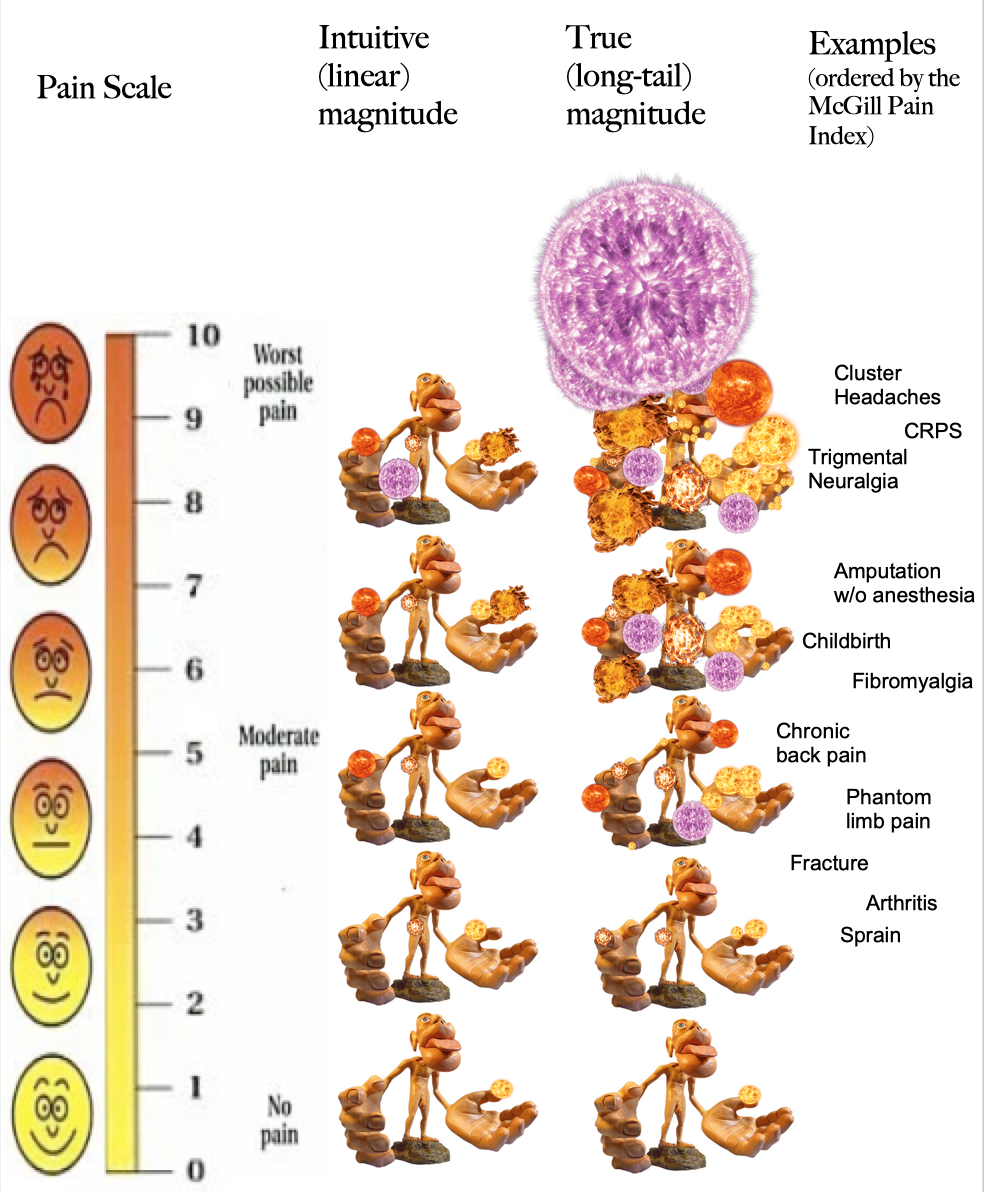
    Fven though we may imagine experiences experiences grow in intensity linearly, there are many reasons to believe that they actually do so exponentially.

    For someone living 20,000 years ago, many things we care about today, say our grades at school or interactions through social media, would probably be extremely alien and unexpected. I would argue that after taking a sober and serious look into the actual nature of value and letting that honestly update the things we prioritize and ways in which we act, one also ends up with a pretty different way of looking at the world and about what one should do, which can be pretty unexpected. Now one starts to spend a lot of time trying to find ways in which to abort cluster headaches, ways in which to better treat chronic pain, or one starts seeing the incredibly and extremely horrible things that happen in factory farming through a lens different from the usual human one in which it just looks like something far away that is through some sketchy logic, justified, we even start doubting the ways in which we should act upon the existence of wild animal suffering, and we start to care a lot more about trying to make our future go in good ways, amongst many other things.

    Imagine there was someone who had a button which activated a machine that would cut his finger 10 minutes after pressing it but they had a tiny bit of fun while pressing it and they willingly chose to press it, clearly not very smart, who in their right mind would press that? I would argue though that this category of problems also includes the type of things mentioned above, people take decisions based on their immediate desires and not considering the effect that may have on other places/moments.

    An important view to add into this is the lens from personal identity. How can we be so sure that we are an separate and independent self that survives over time? what is that which would carry our identity over time? our memories? they are not wormholes into the past, only shapes our brain takes which make representations of things that have happened to us reappear in our experience, plus if someone had the same memories would they automatically be the same entity as you somewhere else? why? if you lost your memories would you suddenly become a different entity? memories aren’t fundamental entities, they are just particular structures in our brain, our atoms are also changing all the time, the same for the shapes of our brain/body (which, as I said, aren’t actually fundamental, two squares with the same width and height aren’t the same entity despite sharing their shape), I would argue that it is not possible to find such a constant «only yours» carrier of identity, and that if we are willing to accept that what we are survives over time, we’d have to also accept that that carrier of identity is the same for all beings, (your atoms once were inside of a star and once may have belonged to another animal, the same for everything that forms you), also there’s the view that sees the universe as one field, which has many segments like the one we are, amongst many other arguments that I won’t mention here. Arguably we should seriously consider the idea that we are actually deep down only one being, or at least that we aren’t actually individuals in the way we usually assume we are, although this unusual views over personal identity may seem like just esoteric stuff that you see revealed on psychedelics and not something out of a scientific, sober understanding, the view of open individualism «we are all one» has been defended by many famous thinkers whose thinking we wouldn’t consider just woo (off course this isn’t necessarily an argument to immediately give it credibility but it’s worth noting), like Arthur Schopenhauer, Erwin Schrödinger and Freeman Dyson amongst many others, and I think that after deeply thinking about the subject, it fits very well into a scientific rationalistic way of looking at reality.

    It can be argued that the suffering of a pig in a slaughterhouse, or of someone having a cluster headache is actually our own, so why make/let ourselves suffer? why shouldn’t we act with the same responsibility we already give many things, to avoid bad stuff happening to beings that probably are only illusorily different from us?. Also, even ignoring this view you can notice that all experiences are equally real and ultimately just expressions of the same universe, I think it’s extremely hard to find a reason why your experience would somehow be more important than the rest just because of it being yours.

    I’d say that we should not let horrible stuff keep happening, we should act to reduce it as much as it is possible, and save ourselves.

    No hay comentarios en Why we should take the experiences of others seriously and why we should be extremely responsible about them.
Página anterior
1 2 3

Blog de WordPress.com.

Compassionate Cosmos

Thoughts on reality and on what matters.

    • About
    • Archives
  • Suscribirse Suscrito
    Compassionate Cosmos

    ¿Tienes una cuenta de WordPress.com? Accede ahora.

  • Compassionate Cosmos
    Ver el sitio en el Lector
    Gestionar las suscripcionesRegístrateIniciar sesión
    Denunciar este contenido
    Contraer esta barra